
Outcomes Following Perioperative Aspiration
Disclaimer: This article is intended solely for informational and educational purposes only. It does not constitute medical advice.
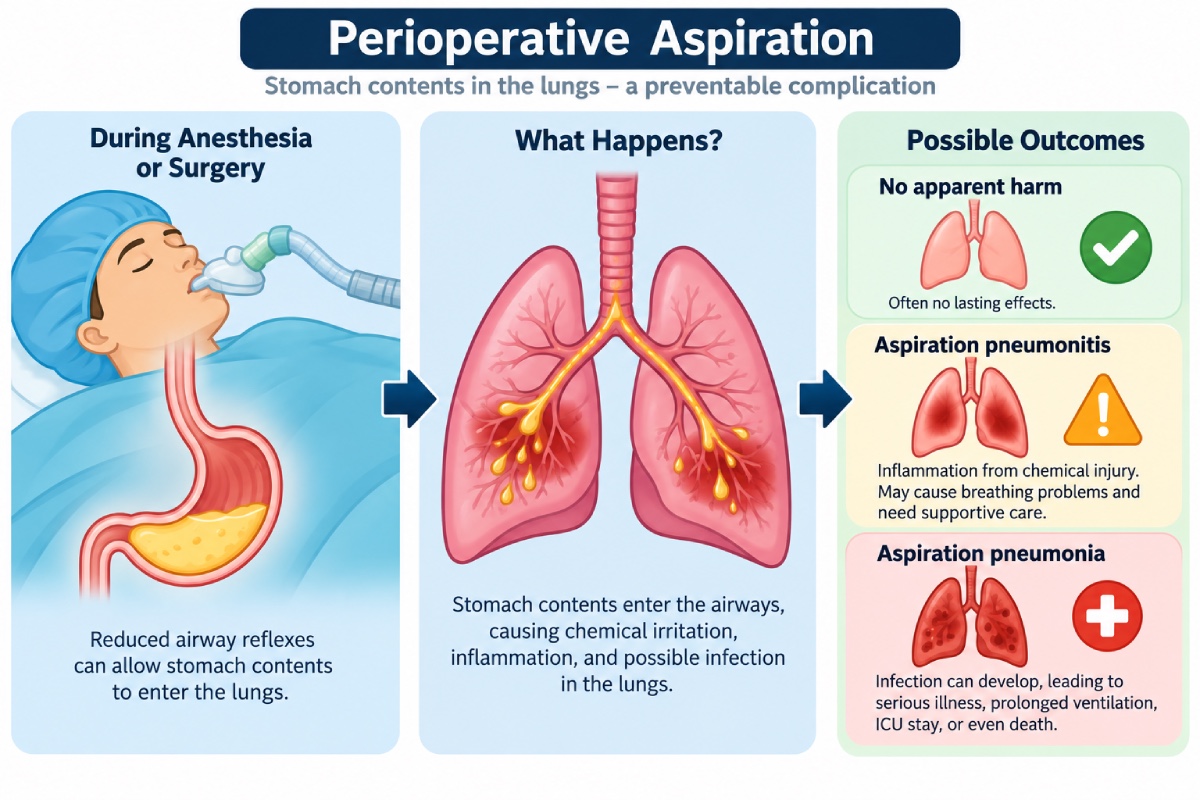
Pulmonary aspiration during the perioperative period can result in varied outcomes. In some patients, little happens beyond a brief episode of coughing or transient hypoxemia. In others, gastric or oropharyngeal contents reaching the lower respiratory tract can trigger chemical pneumonitis, bacterial pneumonia, or more severe acute lung injury. The clinical course depends on what was aspirated, how much aspirated material entered the lungs, and the condition of the patient at the time of the event (1). Deterioration can be rapid when substantial lung injury occurs. Understanding the different pulmonary syndromes that follow aspiration helps explain why some patients recover with minimal treatment while others require prolonged respiratory support.
The most immediate concern after aspiration is aspiration pneumonitis, a chemical injury caused largely by acidic gastric contents. Acid exposure damages the airway and alveolar epithelium and can produce bronchospasm, pulmonary edema, and impaired oxygenation. Symptoms may appear quickly, with cough, wheeze, tachypnea, hypoxemia, and new infiltrates on chest imaging. The presentation can look severe at first and still improve substantially over the next day or two with supportive care (2). This is an important point because aspiration pneumonitis is not, by itself, an infection. Antibiotics are therefore not routinely needed unless the later course suggests bacterial pneumonia.
Aspiration pneumonia, however, involves an infection caused by aspirated material containing pathogenic organisms, often from the oropharynx. The onset may be less abrupt than chemical pneumonitis, and patients are more likely to develop persistent fever, leukocytosis, purulent secretions, and evolving pulmonary infiltrates. The distinction is not always clean in practice. A witnessed aspiration may begin as chemical pneumonitis and later become secondarily infected, while an unwitnessed event may first come to attention when pneumonia is already established (1).
In severe outcomes, perioperative aspiration can cause diffuse inflammatory lung injury and ARDS. Gastric acid, particulate material, and the inflammatory response itself can disrupt the alveolar-capillary barrier, producing pulmonary edema and profound impairment of gas exchange (2). Patients who progress to this stage may require prolonged mechanical ventilation and intensive care. Aspiration is a recognized direct cause of ARDS, although this degree of injury occurs in only a minority of perioperative aspiration events. Fortunately, severe events are uncommon. Many aspiration events resolve without lasting pulmonary injury, while a smaller group develops clinically significant respiratory complications (3).
The lung injury that follows perioperative aspiration most strongly influences patient outcomes. A brief chemical insult may settle with oxygen and observation, whereas pneumonia or ARDS can lead to a much longer and more complicated recovery. The practical challenge is therefore to recognize which patients are developing meaningful lung injury and provide respiratory support before that injury progresses.
References
- Marik PE. Aspiration pneumonitis and aspiration pneumonia. N Engl J Med. 2001;344(9):665-671. doi:10.1056/NEJM200103013440908
- Raghavendran K, Nemzek J, Napolitano LM, Knight PR. Aspiration-induced lung injury. Crit Care Med. 2011;39(4):818-826. doi:10.1097/CCM.0b013e31820a856b
- Warner MA, Warner ME, Weber JG. Clinical significance of pulmonary aspiration during the perioperative period. Anesthesiology. 1993;78(1):56-62. doi:10.1097/00000542-199301000-00010