
Metabolic Acidosis in the OR
Disclaimer: This article is intended solely for informational and educational purposes only. It does not constitute medical advice.
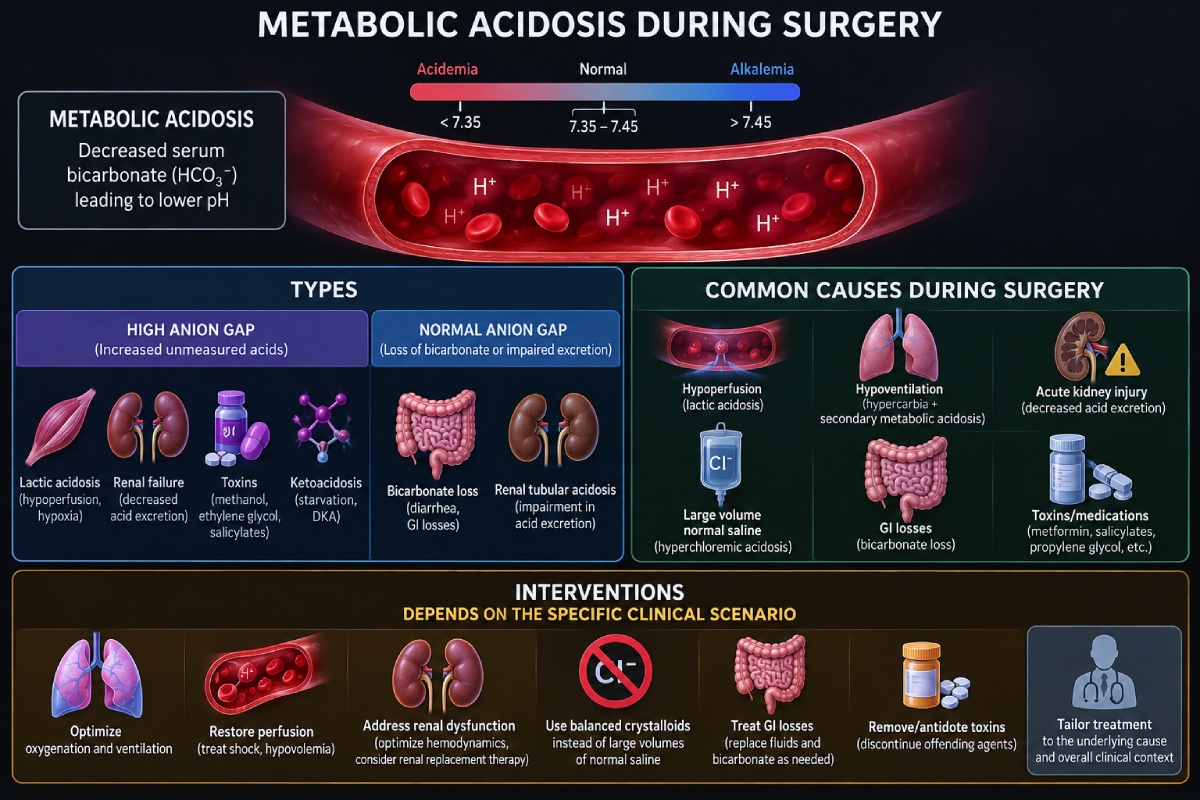
Metabolic acidosis occurs when excess acid accumulates in the body or bicarbonate levels fall, causing the blood pH to decrease. In the operating room (OR), metabolic acidosis may develop from blood loss, poor tissue perfusion, hypotension, sepsis, kidney dysfunction, diabetic ketoacidosis, or the administration of large volumes of intravenous fluids. When severe, metabolic acidosis can have important cardiovascular effects, including decreased cardiac contractility, reduced effectiveness of vasopressors in supporting blood pressure, and an increased risk of arrhythmias. These effects can worsen hemodynamic instability, making it important to identify and treat the underlying cause rather than focusing only on correcting the pH.
Evaluation usually begins with assessing arterial blood gas and serum electrolyte measurements. A low pH with a low bicarbonate level supports the diagnosis, while calculation of the anion gap can help narrow down the cause. A high anion gap is seen when unmeasured acids accumulate in the blood, as can occur with lactic acidosis, ketoacidosis, kidney failure, or certain toxic exposures.
In contrast, a normal anion gap is more often associated with bicarbonate loss or excess chloride. In the OR, lactic acidosis is especially important because it may reflect inadequate tissue perfusion and oxygen delivery. Significant blood loss, low cardiac output, prolonged hypotension, hypoxemia, and sepsis can all contribute. When lactic acidosis is present, management should focus on restoring circulation and oxygen delivery by controlling bleeding, replacing intravascular volume, improving oxygenation, supporting blood pressure, and addressing infection or tissue ischemia when necessary.
Intravenous fluid administration can also contribute to metabolic acidosis in the OR, particularly when large volumes of 0.9% normal saline are given (1). Normal saline contains a relatively high concentration of chloride, and excessive administration can produce hyperchloremic metabolic acidosis. Compared with normal saline, balanced crystalloids such as lactated Ringer’s solution generally produce smaller increases in serum chloride and fewer acid-base disturbances. Although the effect on major postoperative outcomes is less clear, balanced fluids may be preferable when large-volume fluid replacement is anticipated, particularly in patients already at risk for acidosis (2).
Treatment of metabolic acidosis in the OR depends on both its cause and severity. When blood loss or poor perfusion is responsible, treatment should focus on restoring adequate circulating volume and tissue oxygen delivery. Ongoing hemorrhage should be controlled, intravascular volume replaced as appropriate, and hypotension or low cardiac output corrected to improve perfusion. If large volumes of normal saline are contributing to the acidosis, switching to a balanced crystalloid may help prevent further chloride accumulation.
Ventilation is also important because the body compensates for metabolic acidosis by increasing carbon dioxide elimination through the lungs. In mechanically ventilated patients, inadequate minute ventilation can therefore worsen acidemia. Sodium bicarbonate may be considered in selected patients with severe acidemia, but it is not routinely indicated. Evidence suggests that bicarbonate does not provide a clear benefit for all patients with severe metabolic acidosis, although certain patients with acute kidney injury may benefit (3).
Overall, metabolic acidosis in the OR should be treated as a sign of an underlying physiologic problem. Early recognition, careful interpretation of blood gases and electrolytes, and correction of the underlying cause are central to effective management.
References
- Maheshwari K, Turan A, Makarova N, et al. Saline versus Lactated Ringer’s Solution: The Saline or Lactated Ringer’s (SOLAR) Trial. Anesthesiology. 2020;132(4):614-624. doi:10.1097/ALN.0000000000003130
- Bampoe S, Odor PM, Dushianthan A, et al. Perioperative administration of buffered versus non-buffered crystalloid intravenous fluid to improve outcomes following adult surgical procedures. Cochrane Database Syst Rev. 2017;9(9):CD004089. Published 2017 Sep 21. doi:10.1002/14651858.CD004089.pub3
- Jaber S, Paugam C, Futier E, et al. Sodium bicarbonate therapy for patients with severe metabolic acidaemia in the intensive care unit (BICAR-ICU): a multicentre, open-label, randomised controlled, phase 3 trial. Lancet. 2018;392(10141):31-40. doi:10.1016/S0140-6736(18)31080-8